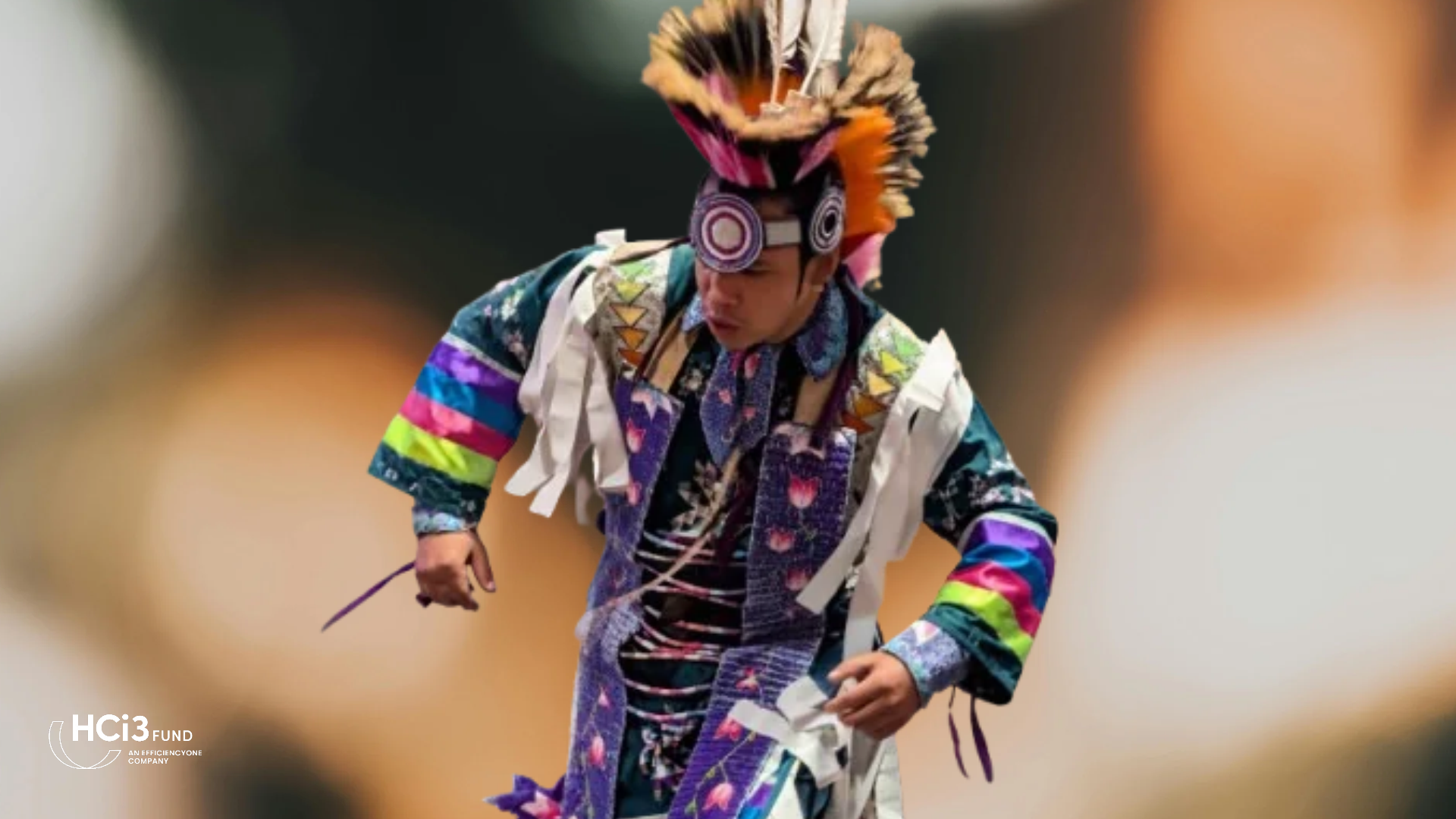
Mi'kmaw dancer Logen Lewis from Lennox Island First Nation at the Atlantic Indigenous-Led Energy Symposium.
Last month, members of the HCi3 team journeyed to Saint John, New Brunswick, for the Atlantic Indigenous-Led Energy Symposium (AILES).
Hosted by the North Shore Mi’kmaq Tribal Council, AILES brings together Indigenous leaders, professionals and community members, including those working across the energy sector, alongside governments, utilities and industry partners. The discussions cover a lot of ground, from clean energy and housing to economic development and community ownership. But the event is also about something harder to capture in an agenda: the experience of different ways of knowing and being brought together. Indigenous worldviews, practices and perspectives are woven throughout the conference, making AILES feel like a lived expression of Etuaptmumk, or Two-Eyed Seeing.
That was a big part of the experience for our team.
“Every conversation wove together Indigenous worldview and industry insight,” said HCi3 Director of Strategic Initiatives, Julia Sable. “We heard viewpoints from successful women who had overcome major challenges, youth taking leadership positions and incredible senior leaders – all woven together by the view of seven generations and the importance of building genuine long- term relationships.”
Throughout the symposium, speakers returned to the importance of involving Indigenous communities from the beginning, while ideas are still taking shape. Trust cannot be added to a project later. It is built over time through honest conversations, shared decision-making, and a willingness to follow through.
As one speaker put it, “The groundwork is the work.”
Seeing with both eyes
AILES was also an opportunity to learn through Etuaptmumk, (Two-Eyed Seeing). The principle, shared by Mi’kmaw Elder Albert Marshall, encourages us to see through one eye with the strengths of Indigenous knowledge and through the other with the strengths of Western knowledge, using both.
This way of seeing could be felt across the symposium.
Conversations about energy were not limited to technology or infrastructure. They included the health of homes, the well-being of communities, the future of young people, and our responsibilities to the land. Underlying these conversations was a commitment to thinking seven generations ahead. It wasn’t simply an idea being discussed, but a worldview that shaped how people approached decisions, measured success, and understood the long-term impact of the work.
There was also a clear sense that Indigenous communities are not waiting on the sidelines of the energy transition. They are leading projects, building businesses, developing local workforces, and creating new models of ownership and partnership.
Chief Terry Richardson of Pabineau First Nation spoke directly about the importance of that participation:
“We are no longer a ward of the government. It is time for First Nations to participate in the economy. And there is no detriment. This helps money stay in Canada. It is not the time for division.”
Community pathways to deep retrofits
HCi3 hosted a workshop at the symposium titled "Community Pathways to Deep Retrofits." The session brought together representatives from Indigenous Clean Energy, Lennox Island First Nation, Pabineau First Nation, the Union of Nova Scotia Mi’kmaq, Efficiency Nova Scotia and the ReCover Initiative.
The discussion focused on how communities can make homes healthier, more comfortable, and more energy efficient through deep retrofits. While technical knowledge is important, the conversation made clear that successful retrofit programs depend just as much on community capacity and strong relationships.
Speakers discussed the value of building skills within communities rather than relying entirely on outside expertise. They also spoke about engaging young people, sharing stories that make the work easier to understand, and looking at housing, health and energy as connected issues.
“What stood out for me at AILES was the sense of connection between participants,” said HCi3 Program Manager Leitha Haysom. “Everyone wanted to learn from each other and share their experiences. Relationships are paramount, and true collaboration stems from early engagement.
Reflections during Mi’kmaw History Month
With Mi’kmaw History Month approaching, AILES gave our team an opportunity to reflect on what the month means, both personally and in our work.
For Melissa H-J (Timiskaming First Nation), it is closely connected to the teachings she has received from Mi’kmaq people throughout her life.
“Mi’kmaw History Month is important to me because I received so many of my teachings from Mi’kmaw people. I’m not connected with my own community, so they’ve brought a wealth of culture, knowledge and teachings into my life.”
Melissa also spoke about the importance of language revitalization and the relationship between culture and wellbeing.
“It has given me a deeper understanding of how important culture is to our well-being and mental health. Mi’kmaw communities do such a wonderful job of welcoming people, sharing their culture and teaching their language. That’s something I’m very grateful for.”
Community Engagement Lead, Mi’kmaw Communities at Efficiency Nova Scotia, Gordon Hart reflected on the role education can play in building a better future.
“There is still so much to learn, and I strongly believe that understanding our history helps us move forward together.”
Drew Bernard, Energy Lead for Lennox Island First Nation, spoke about Mi’kmaw History Month as an opportunity to look back while considering the choices communities are making today.
“Mi’kmaw History Month gives us a chance to look to the past and open that second eye, to truly see with Two-Eyed Seeing, or Etuaptmumk.”
For Drew, looking ahead means walking in partnership with Mother Nature while also drawing on science, technology and innovation.
“Understanding the past helps us make informed choices about the future we want to create in our communities. We can’t truly shape the future without understanding where we’ve come from.”
Carrying the conversations forward
There were many ideas to take home from AILES, but some of the most valuable moments happened between sessions: conversations over coffee, introductions between people working on similar challenges, and stories shared by those with direct experience in their communities.
Those moments are not separate from the work. They are often where the work begins.
We’re grateful to the organizers, speakers, and community members who welcomed our team and shared their knowledge. Some of the most personal learning happened before the main symposium began. Through a waterfront tour that revisited the city’s history from a First Nations perspective, a quill workshop, and a session on Two-Eyed Seeing, members of our team had opportunities to learn through place, practice, and different ways of understanding. Together, those experiences widened our perspective beyond the energy sector and opened more pathways for learning.
As Mi’kmaw History Month continues, AILES is also a reminder that learning begins with listening, and that listening needs to carry into what we do next.