Expanding Local Paper Upcycling in Halifax
Grant award: $10,000

Purush Cannane with bags
For Purushothaman Cannane, founder of Greenii Inc., the idea for his company began with a gap he could not ignore. Paper waste was being collected and recycled, but there was no clear local model for upcycling clean paper waste into new products without putting it through a chemical-heavy recycling process.
“In North America, you see a lot of recycling companies, but there is nothing made for upcycling paper,” Purush says. “I found the gap. That’s why I started this company.”
Greenii was created to turn discarded paper, including newsprint and flyers, into useful packaging products such as paper bags and crinkle paper. Instead of sending clean paper through traditional recycling streams, Greenii uses a low-emission process that avoids harsh chemicals and relies on eco-friendly materials, including starch-based glue. “We have paper waste that is clean, and we need paper bags,” Purush explains. “So, we built a bridge.”
Since launching, Greenii has grown through word of mouth and strong local support. The company has sold more than a quarter million bags without paid advertising and has built relationships with donors and customers across Halifax, including institutions and businesses that now redirect paper to Greenii instead of sending it through conventional recycling. Purush says this shift has been one of the clearest signs that people understand the value of the work: “Before, I had to convince people to donate to the vision. Now people see the vision.”
With support from HCi3, Greenii is moving from a largely manual process to a semi-automated manufacturing model. The company has developed what it believes to be the world’s first semi-automated process specifically designed to upcycle discarded newsprints and flyers into paper bags. In the early stages, every step—joining sheets, cutting, folding, and gluing—was done by hand. The HCi3-supported expansion has helped Greenii purchase, develop, and adapt equipment for its process, including cutting, folding, gluing, dust collection, and paper handling systems.
The impact of those upgrades has been significant. Since June 2025, Greenii has diverted approximately 34 tonnes of paper waste, avoided an estimated 296 tonnes (296,000 kg) of CO₂e emissions, and preserved approximately 578 trees. Productivity has increased tenfold compared to fully manual processes, and revenue has grown by 50 to 60% year-over-year. These improvements are helping Greenii increase local production while reducing reliance on virgin fibre, plastic packaging, and imported packaging products.
The expansion has also changed what is possible for the business. “Previously, if a big company asked for 5,000 or 10,000 bags, it was very difficult,” Purush says. “Now, with the machines, we can make it faster. Scaling is a real opportunity now.”
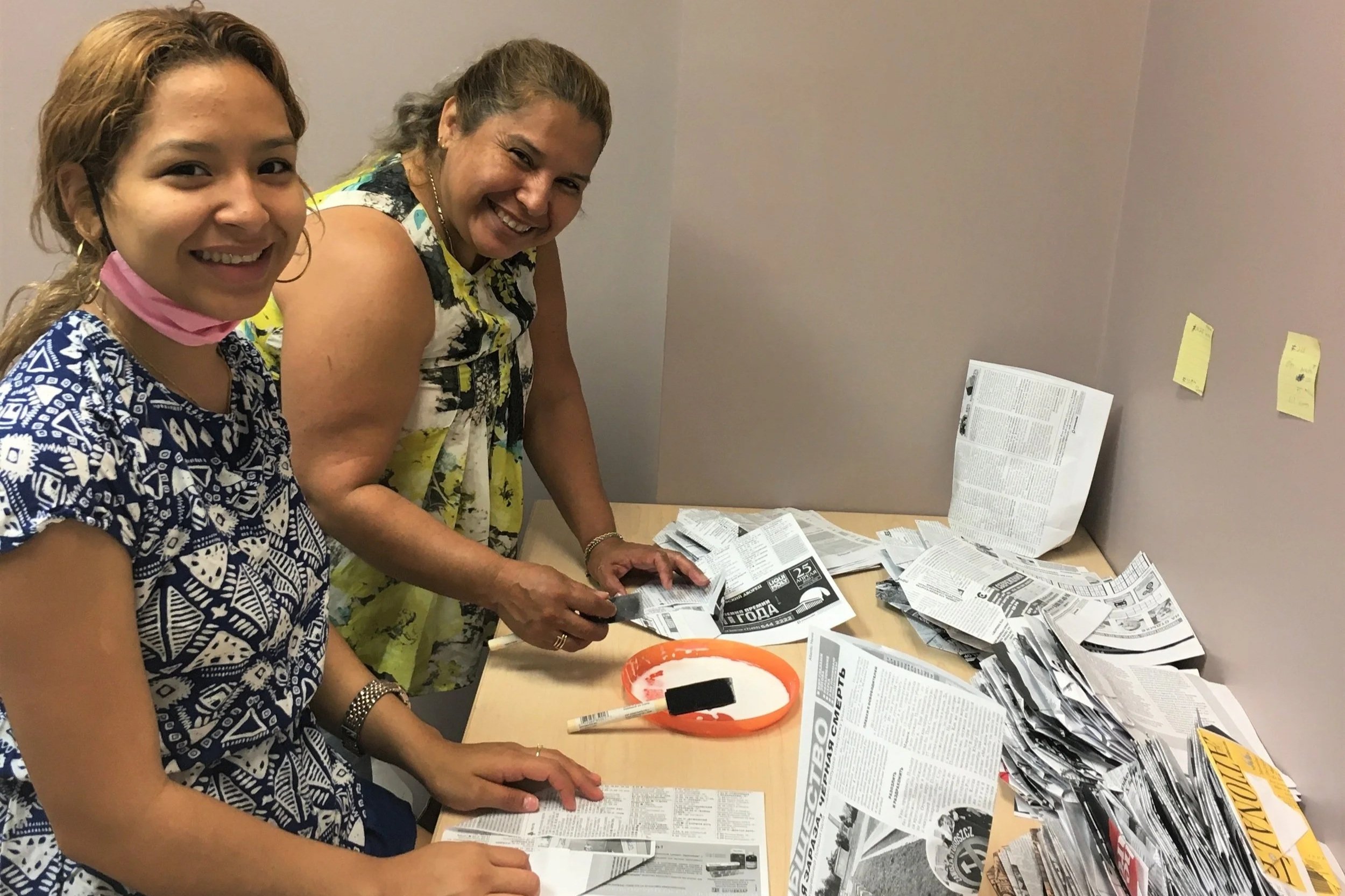
Immigrant newcome women making Greenii paper bags
A key part of Greenii’s model is its connection to employment and skills development. Through partnerships such as Metroworks Employment Centre, Greenii has provided flexible work opportunities to women from refugee and immigrant communities, including people who may face barriers related to language, childcare, transportation, or lack of Canadian work experience. Workers have been trained in production, quality control, and consistency, building skills that can support future employment.
For Purush, this social impact is part of the business model, not separate from it. “Some people told me, ‘Now I got a job. Your teaching helped me,’” he says. “That makes me feel positive.”
As Greenii grows, Purush sees opportunities to replicate the model in other communities across Canada. The company has spent years learning which equipment, processes, and partnerships are needed to make paper upcycling work at a larger scale. Future plans could include community-based training, partnerships with employment organizations, and a broader marketplace for locally made upcycled packaging.
In addition to its signature paper bags and crinkle paper, Greenii now offers a growing range of Canadian-made eco-friendly packaging products, including tissue paper, labels, and mailer (gift) boxes. This broader product offering helps businesses transition toward more sustainable packaging solutions while supporting local manufacturing.
“What we proved is that this model works,” Purush says. “It is not just a random business idea. We have paying customers, we have donors, and we have a process.”
By turning paper waste into useful products, Greenii is showing how local manufacturing can reduce emissions, support circular economy practices, and create flexible employment pathways. With its HCi3-supported expansion, the company is building a stronger foundation for a model that can grow beyond Halifax and extend the environmental and community benefits at its centre.